
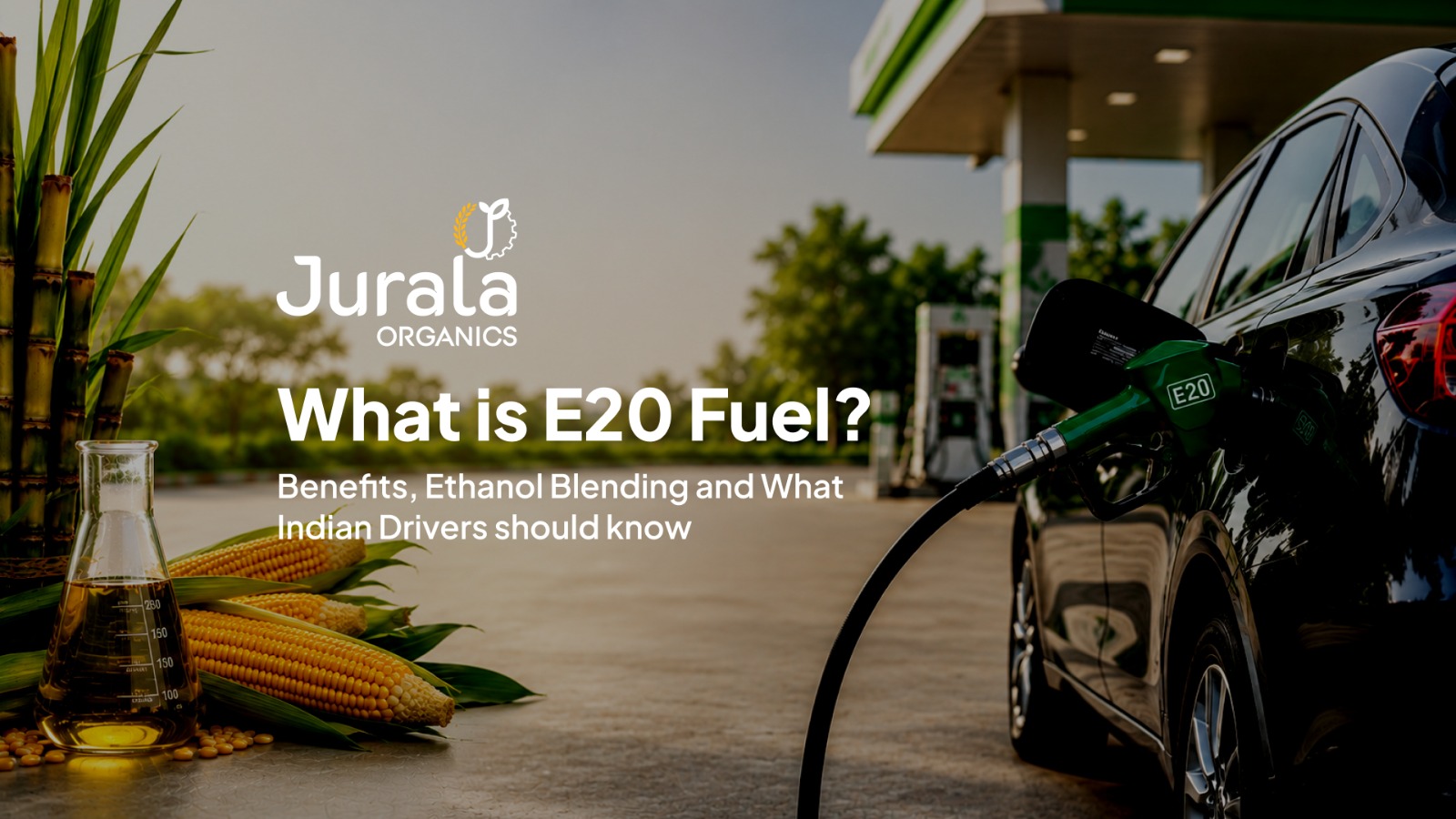
E20 fuel is petrol blended with 20% ethanol and 80% petrol by volume. As India increases ethanol blending in petrol, E20 is becoming an important part of the country’s energy and transportation landscape.
But what exactly is E20 fuel? Why is India moving toward higher ethanol blending? Does E20 affect vehicle mileage? And how does the growth of ethanol benefit industries such as animal feed and industrial CO₂?
This guide explains E20 fuel, its benefits, vehicle compatibility, ethanol production and how companies such as Jurala contribute to the broader ethanol value chain.
E20 fuel refers to petrol containing up to 20% ethanol blended with 80% petrol by volume.
Ethanol is a renewable alcohol-based fuel that can be produced from agricultural feedstocks, including grains. Through processes such as fermentation and distillation, suitable feedstocks are converted into fuel-grade ethanol.
The ethanol can then be blended with petrol to create ethanol-blended fuels.
Common ethanol blends include:
As India moves toward higher ethanol blending, E20 is becoming increasingly relevant for fuel producers, vehicle manufacturers and consumers.
India’s growing focus on ethanol blending is connected to several energy, agricultural and environmental objectives.
India imports a large portion of its crude-oil requirements. Increasing the use of domestically produced ethanol can reduce the amount of petroleum required from conventional fossil-fuel sources.
Grain-based ethanol production creates additional demand for suitable agricultural feedstocks. This connects agriculture with India’s growing renewable-fuel industry.
Unlike petroleum, ethanol can be produced from renewable biological resources. When produced efficiently and responsibly, ethanol can contribute to a more diversified energy mix.
Higher ethanol blending supports investment in ethanol manufacturing, transportation, storage, technology and related industries.
This creates opportunities across the wider ethanol value chain, from agricultural feedstocks to fuel ethanol and valuable co-products.
To understand E20 fuel, it is useful to understand the ethanol production process.
In grain-based ethanol production, the feedstock is first processed so that fermentable sugars can be made available. These sugars are then fermented to produce alcohol.
The fermented material undergoes distillation and further processing to obtain fuel-grade ethanol.
However, ethanol is not the only valuable output from the process.
Grain-based ethanol production can also generate valuable co-products such as Distillers Dried Grains with Solubles (DDGS). In addition, CO₂ generated during fermentation can potentially be captured, purified and supplied for commercial applications.
Learn more about the ethanol production process and how grain can be converted into fuel ethanol.
E20 fuel can provide benefits at both the national and industrial levels.
With 20% ethanol in the blend, E20 can reduce the quantity of conventional petrol required compared with petrol containing a lower ethanol percentage.
Domestic ethanol production gives India another source of fuel energy and can contribute to reducing dependence on imported petroleum.
Ethanol produced from agricultural resources provides a renewable component for transportation fuel.
Growing demand for ethanol feedstocks can create additional market opportunities for agricultural producers and related supply chains.
The expansion of ethanol blending supports businesses involved in production, logistics, equipment, storage and related value-added products.
One of the most common questions about E20 is whether it affects vehicle mileage.
Ethanol has a lower energy content per litre than petrol. Therefore, higher ethanol blends can result in some reduction in fuel economy compared with lower-ethanol petrol.
However, the actual impact depends on several factors, including:
The effect can therefore vary from one vehicle to another.
Vehicle compatibility is an important consideration when using E20 fuel.
Vehicles designed or approved for E20 can operate with the fuel according to the manufacturer’s specifications. However, compatibility can differ depending on the vehicle model, engine design, manufacturing year and fuel-system components.
Before using E20, vehicle owners should check their vehicle owner’s manual or manufacturer’s official guidance.
If you are unsure about compatibility, always follow the vehicle manufacturer’s recommendation.
The benefits of ethanol production extend beyond producing fuel.
In grain-based ethanol production, agricultural feedstocks can be converted into multiple valuable products.
A simplified value chain looks like this:
Agricultural Grain → Ethanol → Fuel
But the process can also create:
Ethanol Production → DDGS → Animal Feed
and
Ethanol Fermentation → CO₂ Recovery → Industrial Applications
This creates opportunities for a more efficient and circular use of agricultural resources.
Jurala’s business model is connected to this integrated value chain, with activities across fuel ethanol, DDGS and CO₂-related products.
One of the important co-products associated with grain-based ethanol production is DDGS.
DDGS can be used as an ingredient in formulated animal feed because it can provide protein, energy and other nutrients.
This means ethanol production can create value beyond fuel by supplying useful feed ingredients to the livestock and poultry sectors.
If you want to understand the nutritional role of DDGS, explore Jurala’s article on high-protein livestock feed.
Jurala’s DDGS solutions are part of this wider ethanol value chain.
Another valuable opportunity comes from the CO₂ generated during fermentation.
Instead of treating fermentation CO₂ only as a waste stream, ethanol facilities can capture, purify and process it for commercial applications where appropriate.
Captured CO₂ can be used in areas such as:
Jurala also operates in the CO₂ and dry ice segment, connecting ethanol production with the growing market for recovered and processed CO₂.
The growth of E20 fuel is creating opportunities across the entire ethanol ecosystem.
Jurala focuses on an interconnected product value chain involving:
Grain → Fuel Ethanol → DDGS → CO₂
This approach helps demonstrate how modern ethanol production can generate multiple valuable outputs from agricultural feedstocks.
For businesses looking for solutions related to fuel ethanol, DDGS or CO₂, understanding this integrated value chain can be important when evaluating suppliers and partners.
Jurala’s focus on these interconnected products positions the company within India’s evolving biofuel and value-added agricultural ecosystem.
E20 is more than a change in petrol composition. It represents part of India’s broader transition toward greater use of domestically produced renewable fuel components.
As ethanol blending expands, the industry will increasingly depend on:
The growth of ethanol can also strengthen connected industries such as animal feed and industrial CO₂.
For companies operating across these sectors, the opportunity extends beyond ethanol itself.
E20 means petrol blended with 20% ethanol and 80% petrol by volume.
E20 is ethanol-blended petrol. It contains 20% ethanol, so its composition differs from petrol containing a lower ethanol percentage.
E20 is part of India’s broader ethanol-blending strategy, which aims to support energy diversification, domestic ethanol production, agriculture and reduced dependence on imported petroleum.
E20 may result in some reduction in fuel economy because ethanol contains less energy per litre than petrol. The actual impact depends on the vehicle, engine technology and driving conditions.
No. Vehicle compatibility depends on the vehicle’s design and manufacturer’s specifications. Owners should check their vehicle manual or manufacturer’s official guidance.
E20 requires ethanol as a blending component. Ethanol can be produced from suitable agricultural feedstocks through processes such as fermentation and distillation.
DDGS stands for Distillers Dried Grains with Solubles. It is a valuable co-product of grain-based ethanol production and can be used as an ingredient in animal feed.
CO₂ is generated during fermentation. Depending on the plant and process, it can be captured, purified and processed for commercial applications.
E20 fuel is becoming an important part of India’s evolving energy landscape. By blending 20% ethanol with petrol, E20 supports the wider development of India’s domestic ethanol industry while creating connections between agriculture, renewable fuel and value-added products.
The impact of ethanol production extends beyond fuel. DDGS can support the animal-feed industry, while recovered CO₂ can serve industrial and commercial applications.
For businesses operating in the ethanol, animal-feed and industrial-gas sectors, this integrated value chain creates new opportunities.
Jurala is part of this evolving ecosystem, with a focus on fuel ethanol, DDGS and CO₂-related solutions.
Explore Jurala’s products and solutions to learn more about its fuel ethanol, DDGS and CO₂ capabilities, or connect with the Jurala team to discuss your business requirements.