
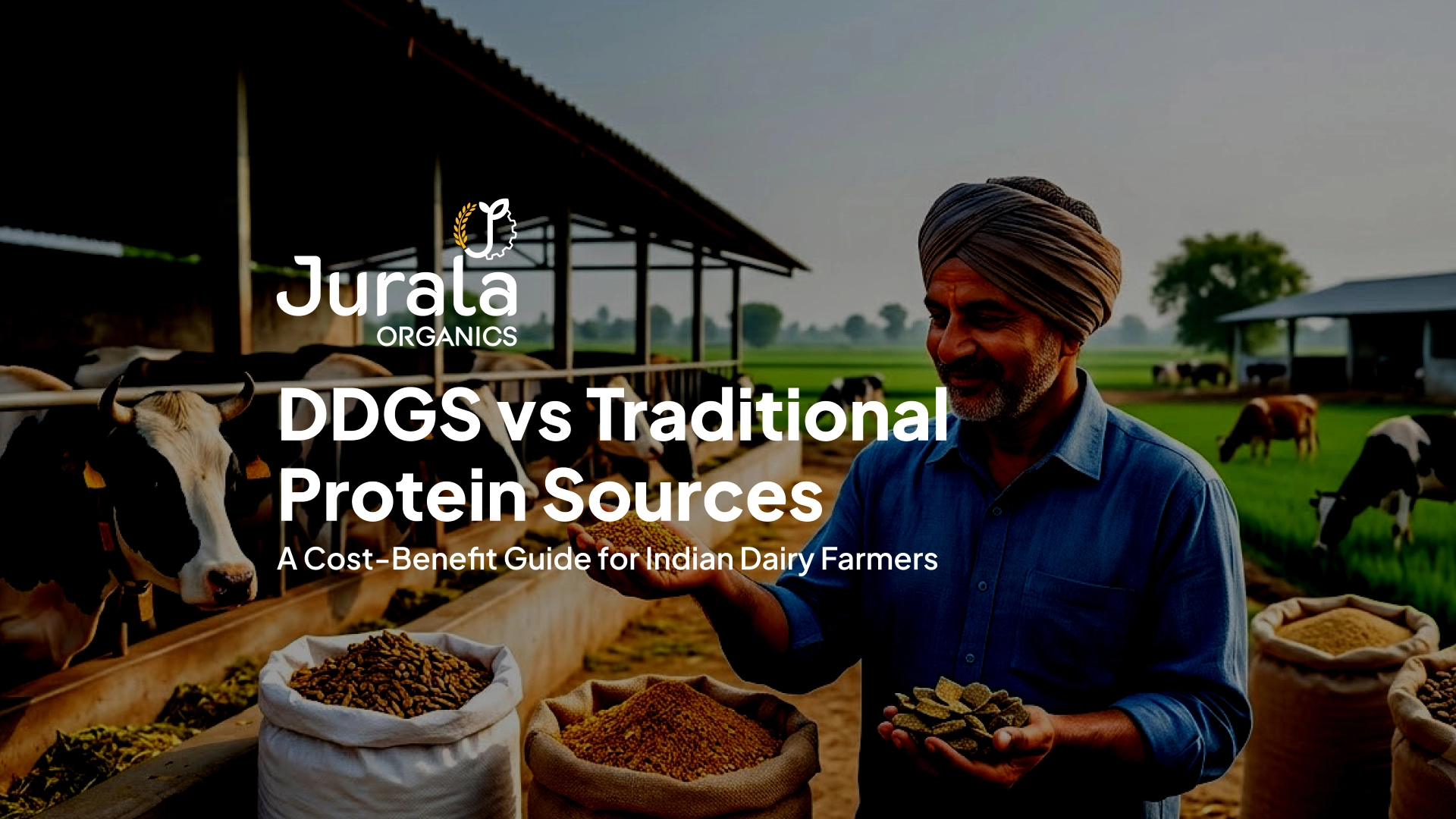
Feed costs typically account for the largest share of expenses in dairy and poultry operations, which makes ingredient selection one of the most important decisions a farmer or feed manufacturer can make. Soybean meal has long been the default protein source across India, but Dried Distillers Grains with Solubles (DDGS) is increasingly being considered as a viable, cost-effective alternative. Here’s how the two compare, and how farmers can make an informed decision between them.
Soybean meal is produced by extracting oil from soybeans and processing the remaining solids into a protein-rich meal. It has long been considered a gold standard for protein quality in animal feed due to its favorable amino acid profile, particularly for poultry.
DDGS, by contrast, is a co-product of ethanol production. After grain — whether maize, broken rice, or other starch-based feedstock — is fermented and distilled to produce ethanol, the remaining solids are dried and processed into a protein- and fiber-rich feed ingredient. The two products come from entirely different industrial processes, but both have found a place in modern animal nutrition.
Soybean meal generally offers a higher crude protein percentage than DDGS, often in the 44–48% range compared to DDGS’s typical 25–30%. However, this comparison alone doesn’t tell the full story. DDGS brings additional fat and fiber content that soybean meal lacks, meaning that on a total energy and nutrient basis, the two ingredients often complement each other rather than directly compete — many balanced feed formulations use both in combination, leveraging soybean meal’s protein density alongside DDGS’s fiber and energy contribution.
Nutritionists formulating rations typically look beyond a single metric like crude protein percentage, instead balancing the full nutrient profile — protein, energy, fiber, and minerals — across all ingredients in a ration to hit target performance outcomes for the specific animal class being fed.
International markets heavily influence soybean meal prices in India, since a significant portion of the country’s soybean and soymeal supply is tied to import dynamics and global commodity price swings. This exposes dairy and poultry farmers to price volatility outside their control — a currency fluctuation or a poor harvest in a major exporting country can ripple through to feed costs on an Indian farm within weeks.
DDGS, by contrast, is a domestically produced co-product of the ethanol industry. As grain-based ethanol production scales up under India’s Ethanol Blending Programme, DDGS availability is increasing in tandem — creating a more locally anchored, and often more price-stable, feed ingredient option. Because DDGS pricing is tied more closely to domestic grain markets and ethanol production economics rather than international soybean futures, it can offer a degree of insulation from the kind of import-driven price shocks that periodically affect soybean meal costs.
Because DDGS is generated continuously as a co-product of ethanol production rather than harvested seasonally, supply tends to be steady throughout the year. This is a meaningful advantage for large dairy operations and feed manufacturers who need predictable, uninterrupted ingredient flow to maintain consistent feed formulations without having to constantly reformulate around ingredient availability.
Soybean, on the other hand, is subject to seasonal harvest cycles and can see availability tighten during certain periods of the year, sometimes driving short-term price spikes. Feed manufacturers relying heavily on soybean meal often need to build in inventory buffers or hedge against seasonal price variability — an added layer of complexity that a steadier DDGS supply can help reduce.
Both ingredients are well established in animal nutrition science, but their performance varies by species and life stage:
Dairy Cattle: DDGS is widely used as a partial protein and energy supplement, particularly valued for its fiber content, which supports rumen health and helps maintain proper digestive function in high-producing dairy animals.
Poultry: Soybean meal remains the primary protein source due to its amino acid profile, particularly its lysine content, though DDGS can be included at moderate inclusion rates to reduce overall feed costs without significantly affecting bird performance.
Aquaculture: Both ingredients see use depending on species-specific nutritional requirements and formulation goals, with inclusion rates often determined through trial-based optimization for each species.
Farmers and feed manufacturers considering a shift toward greater DDGS inclusion should keep a few factors in mind:
Inclusion Rates: DDGS is nutrient-dense, and inclusion levels should be calibrated to the specific animal class to avoid mineral imbalances, particularly around phosphorus and sulfur, which are naturally concentrated in the co-product.
Sourcing Consistency: Protein and moisture content can vary between suppliers, so working with a producer using standardized, energy-efficient drying processes helps maintain batch-to-batch consistency — an important factor when formulating precise rations at scale.
Blended Formulations: Many nutritionists recommend combining DDGS with soybean meal or other protein sources rather than fully replacing one with the other, optimizing both cost and nutritional balance across the full ration.
Animal-Specific Tolerance: Different animal classes have different optimal inclusion ranges. Working with a qualified animal nutritionist to determine the right formulation for a specific herd or flock helps ensure the cost savings from DDGS don’t come at the expense of animal performance.
For a mid-sized dairy operation formulating rations for a herd of several hundred animals, even modest reductions in per-kilogram feed cost can translate into meaningful annual savings once scaled across daily feeding volumes. Because DDGS often comes at a lower per-unit cost than soybean meal while still contributing meaningfully to the protein and energy needs of the ration, many operations find that partial substitution — rather than full replacement — delivers the best balance of cost savings and nutritional performance.
DDGS isn’t necessarily a wholesale replacement for soybean meal, but it offers a compelling, domestically produced complement that can meaningfully reduce feed costs while maintaining strong nutritional outcomes. As India’s ethanol industry continues to expand, DDGS availability is likely to grow alongside it — giving dairy and poultry producers an increasingly accessible tool for building more cost-efficient, locally sourced feed rations that are less exposed to the volatility of global commodity markets.