
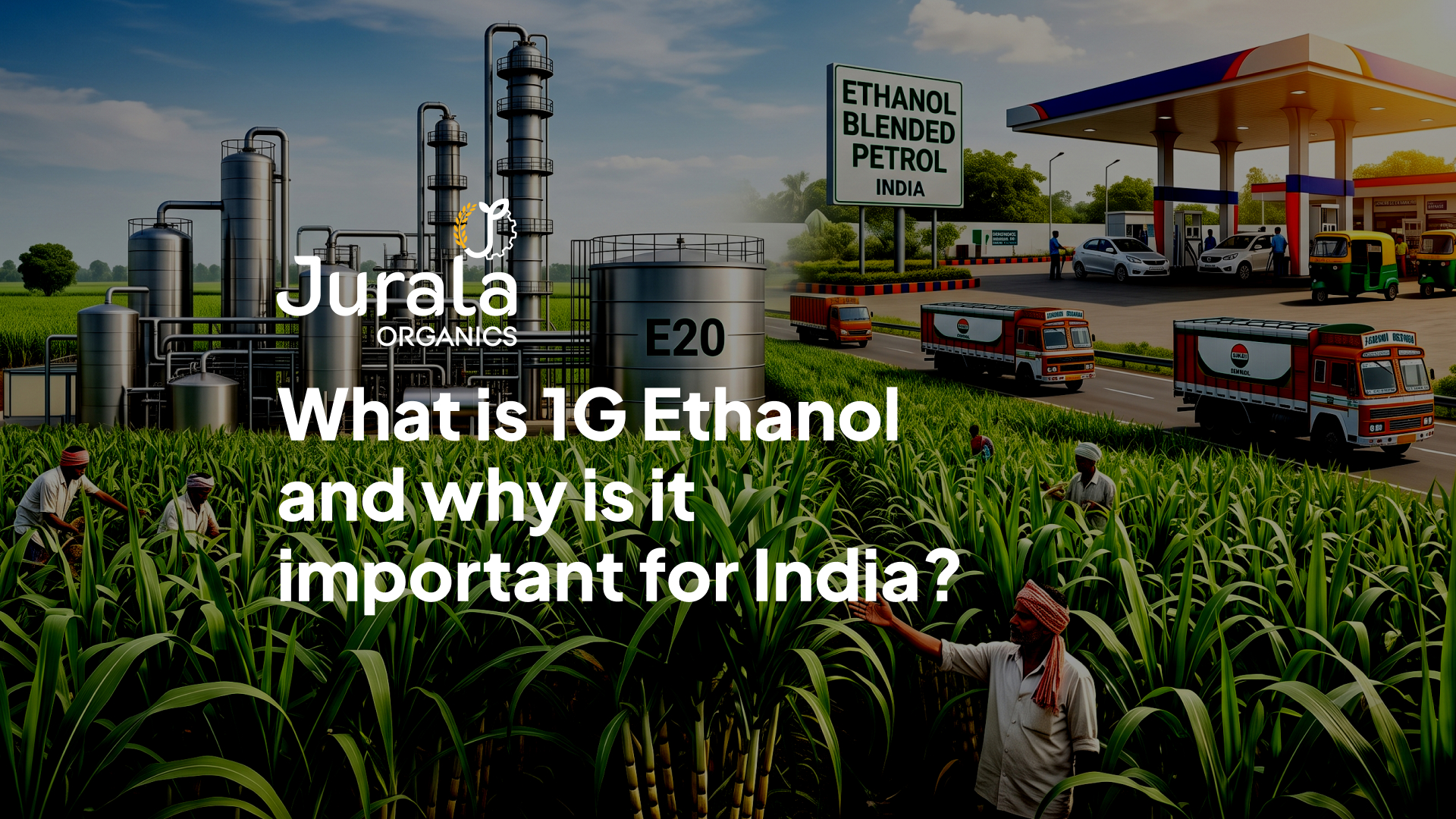
India’s push toward energy independence and cleaner fuels has put ethanol production in India at the center of national conversation. Among the various ethanol production pathways, 1G Ethanol (First Generation Ethanol) remains the backbone of the country’s biofuel India strategy. But what exactly is 1G ethanol, and why does it matter so much for India’s economy, farmers, and environment?
1G Ethanol, or first-generation ethanol, is a biofuel produced by fermenting the sugars found in food crops. In India, the primary feedstocks used for sugarcane ethanol and grain-based ethanol India production are:
The ethanol production process is straightforward: sugars from these crops are extracted, fermented using yeast, and then distilled to produce ethanol. This ethanol is later blended with petrol under the Ethanol Blended Petrol Programme to create fuels like E10 ethanol or E20 ethanol, reducing the need for imported crude oil.
The term “1G” distinguishes it from Second Generation (2G) ethanol, made from agricultural waste and non-food biomass like crop residue, straw, and bagasse — a more sustainable but technologically complex process.
These concerns are part of why India is simultaneously investing in 2G and 3G ethanol technologies for a more balanced, long-term agricultural biofuel India mix.
Through the National Policy on Biofuels India and NITI Aayog’s roadmap, the government continues to incentivize 1G ethanol via price support, interest subvention, and ethanol subsidy India schemes for distillery infrastructure. As India moves toward E20 and beyond, 1G ethanol will remain a critical bridge technology — supporting farmers, cutting import bills, and reducing emissions, even as the biofuel roadmap India scales toward next-generation solutions.
1G Ethanol is more than a biofuel — it’s a strategic lever connecting India’s agricultural economy, energy security, and clean energy India goals. For a country balancing food demand, farmer welfare, and a growing energy appetite, 1G ethanol offers a practical, scalable solution while the groundwork for next-generation biofuels continues to develop.
Q1. What is 1G ethanol made from?
1G ethanol is made from food-based feedstocks like sugarcane juice, molasses, maize, broken rice, and surplus food grains through fermentation and distillation.
Q2. What is the difference between 1G, 2G, and 3G ethanol?
1G ethanol comes from food crops (sugarcane, grains). 2G ethanol comes from agricultural waste and non-food biomass (crop residue, straw, bagasse). 3G ethanol is derived from algae and other advanced biomass sources still under development.
Q3. What is India’s current ethanol blending target?
India achieved its E10 (10% ethanol blending) target ahead of schedule and is now working toward nationwide E20 (20% blending) under the Ethanol Blended Petrol Programme.
Q4. Why is ethanol blending important for India’s economy?
It reduces India’s dependence on imported crude oil (over 85% import-dependent), saves foreign exchange, supports farmer incomes, and helps manage domestic sugar surplus.
Q5. Does using food crops for ethanol affect food security?
This is a genuine concern known as the “food vs. fuel” debate. It’s part of why India is investing in 2G and 3G ethanol technologies that use non-food biomass instead of grains and sugarcane.
Q6. How does 1G ethanol benefit farmers?
It creates an additional, often more stable, revenue stream by allowing farmers and mills to sell surplus sugarcane, molasses, and grains to distilleries. Grain-based distilleries also produce DDGS as nutritious cattle feed, adding a second income stream on top of ethanol sales.
Q7. Is ethanol-blended petrol safe for vehicles?
Yes. Vehicles compatible with E10 and E20 blends (most modern vehicles in India are BS6-compliant and E20-ready) run safely on ethanol-blended fuel, with the added benefit of lower emissions. Read more on what E20 fuel means for Indian drivers.
Q8. How is ethanol actually produced?
Ethanol production involves fermenting sugars from crops using yeast, then distilling the mixture to isolate ethanol. See our detailed breakdown of the ethanol production process from grain to green fuel.