
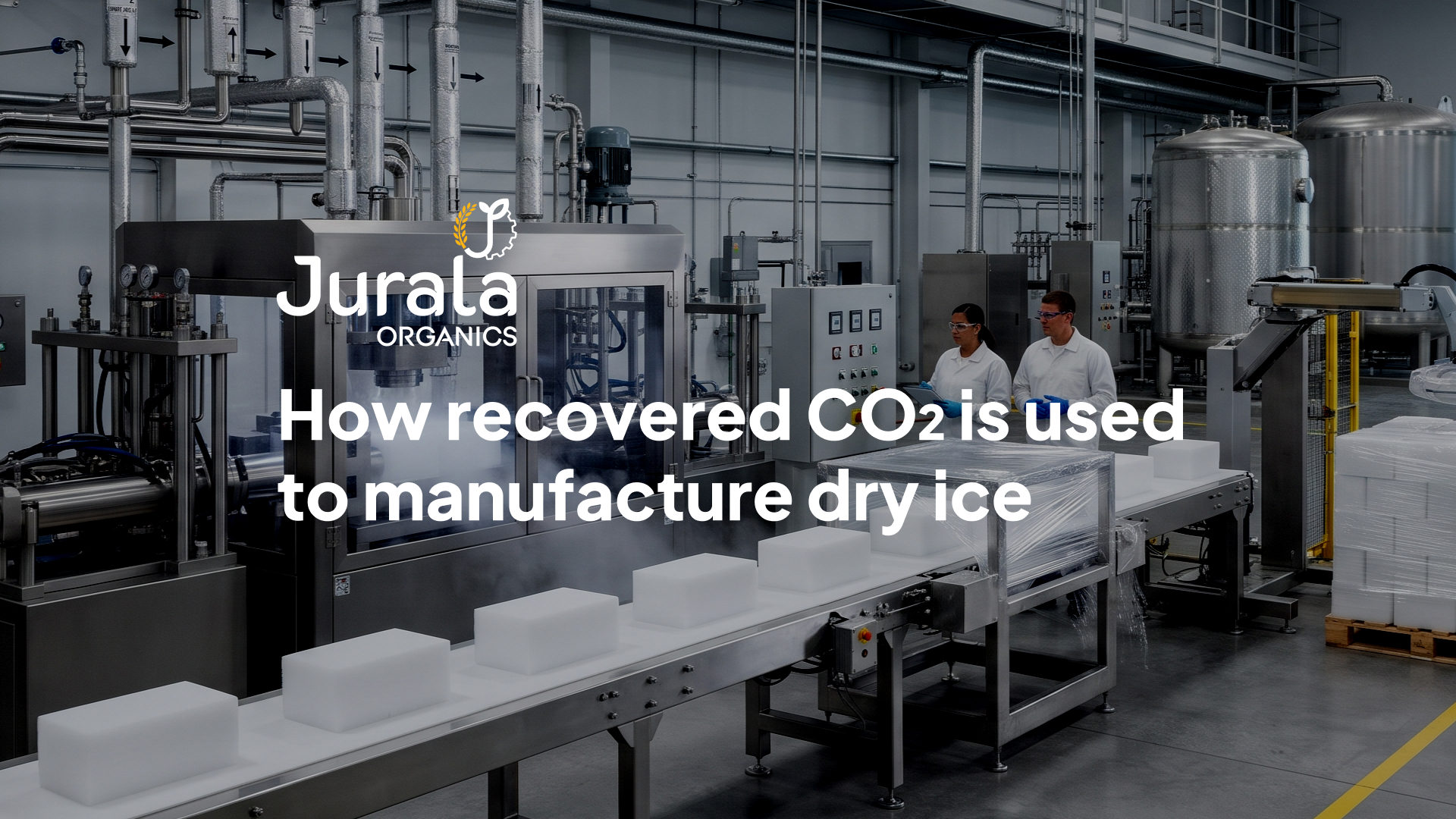
How Recovered CO₂ Is Used to Manufacture Dry Ice
Introduction
Carbon dioxide (CO₂) is an important raw material used across several industries. Beyond its applications in beverages, food processing, and industrial operations, recovered CO₂ can also be used to manufacture dry ice.
Dry ice is the solid form of carbon dioxide. Unlike ordinary water ice, it changes directly from a solid into gas under normal atmospheric conditions, without becoming liquid. This property makes dry ice useful for temperature-controlled transportation, food preservation, industrial cleaning, and other specialised applications.
But how does recovered CO₂ become dry ice? The process involves capturing carbon dioxide, purifying it, converting it into liquid CO₂, and then transforming it into solid form.
In this blog, we explain the dry ice manufacturing process, its major stages, applications, and the importance of CO₂ recovery.
What Is Recovered CO₂?
Recovered CO₂ is carbon dioxide captured from an industrial process instead of being released directly into the atmosphere. One potential source is ethanol production, where fermentation generates a CO₂-rich gas stream.
Before this gas can be used commercially, it may require treatment to remove moisture and other impurities. The purification process depends on the source of the gas and the intended application.
After meeting the required quality specifications, recovered CO₂ can be supplied for applications such as beverage carbonation, food processing, and dry ice manufacturing.
The US Environmental Protection Agency identifies ethanol production as one of the industrial sources from which carbon dioxide can be recovered for further use.
What Is Dry Ice?
Dry ice is solid carbon dioxide, commonly produced in blocks, slices, or pellets. It is valued for its extremely low temperature of approximately −78.5°C at atmospheric pressure.
Unlike conventional ice, dry ice does not leave a pool of liquid water as it warms. Instead, it sublimates, changing directly into carbon dioxide gas.
These properties make dry ice suitable for applications where strong cooling is needed without adding liquid water to the product or surrounding area.
How Is CO₂ Converted Into Dry Ice?
The manufacturing process generally involves five key stages.
1. CO₂ Recovery
The process begins with capturing a carbon dioxide-rich gas stream from a suitable industrial source, such as ethanol fermentation.
The quantity and quality of the recovered gas depend on the production process and recovery system. Capturing CO₂ provides a potential feedstock for further industrial use.
2. Purification of CO₂
Raw recovered CO₂ may contain moisture and other unwanted compounds. These impurities must be reduced to meet the specifications required for the intended application.
Depending on the source and product requirements, purification can include filtration, drying, and other treatment stages.
Quality control is especially important when dry ice is intended for food handling, pharmaceuticals, or other sensitive applications. Food-grade use requires appropriate quality verification, not simply a high overall CO₂ purity figure.
3. Compression and Liquefaction
Once the gas has been treated, it is compressed and cooled to convert it into liquid carbon dioxide under suitable pressure and temperature conditions.
Liquid CO₂ is then stored in specialised equipment and supplied to dry ice manufacturing machinery.
Proper pressure control and storage
Frequently Asked Questions
- How is CO₂ converted into dry ice?
CO₂ is purified, compressed, and cooled to form liquid carbon dioxide. The liquid is then expanded rapidly to produce CO₂ snow, which is compressed into dry ice blocks or pellets.
- Can recovered CO₂ from ethanol production be used to make dry ice?
Yes. CO₂ recovered from ethanol fermentation can be used as a feedstock for dry ice production, provided it is properly purified and meets the quality specifications required for the intended use.
- What is the temperature of dry ice?
Dry ice has a temperature of approximately −78.5°C at atmospheric pressure, making it useful for specialised cooling and temperature-controlled transportation.
- What are the main uses of dry ice?
Dry ice is used in food transportation, pharmaceutical logistics, industrial cleaning, laboratory cooling, and other applications that require very low temperatures.
- Is dry ice manufacturing from recovered CO₂ environmentally friendly?
Using recovered CO₂ can improve resource utilisation, but the overall environmental impact depends on the source of CO₂, energy consumption, purification, transport, and the final use of the product.
- Is dry ice safe to handle?
Dry ice requires careful handling because it can cause cold burns and releases CO₂ gas as it sublimates. Use appropriate protective equipment, ensure good ventilation, and never store it in an airtight container.